
IEC Connectors


About IEC 60320 "Appliance couplers for household and similar general purposes"
IEC connectors are widely used on equipment with detachable power cords. There are about 13 different designs ranging from the little oblong C1 plug used on electric shavers to the C19 square connector used in computer server-farms. The most common IEC connector and the one meant if no other information is given is the C13 line socket - on the end of a cable. The C13 mates with a C14 inlet on equipment such as computers. Other fairly common IEC connectors are the C5 - C6 "cloverleaf" and the C7 - C8 "figure of eight" types. Odd numbers refer to the female connector or socket and even numbers to the male connector or plug.| C1 / C2 | C3 / C4 | C5/ C6 | C7 / C8 | C9 / C10 | C11 / 12 | C13 / C14 | C15 / C16 | C17/C18 | C19 / C20 | C21 / C22 | C23 / C24 |
|---|---|---|---|---|---|---|---|---|---|---|---|
 |  |  |  |  |  |  |  |  |  |  |  |
 |  |  |  |  |  |  |  |  |  |  |  |
People are commonly confused by the terms used for IEC connectors. People think of the IEC C13 as a plug and often call it that, but look at the electrical connectors and it is clearly a socket.
IEC connectors are normally used at the equipment end of the cable rather than at the wall outlet. The wall outlets in buildings are almost invariably in a distinct national style - like the UK 3-pin "BS1363" socket which has a corresponding plug. IEC connectors are sometimes used where a great deal of IT equipment is expected such as in computer and communication racks.
The IEC
The IEC is an international, non governmental standards organisation with participation of about 10,000 engineers from 130 countries. It was formed in the first years of the 20th century (1906) by the British IEE and the American IEEE and now acts as a wide-ranging forum for national electrical and electronic organisations alongside the ISO and ITU. The IEC is responsible for many of the standards taken for granted by the engineering community - things like 19 inch rack or the graphical symbols used on equipment. Another notable standard is IEC 60309 "Plugs, socket-outlets and couplers for industrial purposes". If your equipment has a big circular plug it's probably one of those.
Why an IEC Connector?
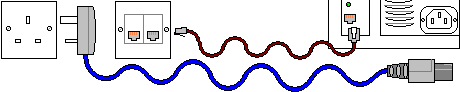
Electrical connectors can be made in almost infinite variety. Until the later 20th century the electrical industries in different countries tended to adopt different standards - the American "NEMA", French DIN and BS 1363 power plugs being examples. Design variation with little purpose is bad for manufacturers wanting low cost component supplies and for customers wanting spares.
Mass produced low-cost equipment is often designed with a "captive" power cord - the power cable goes through a strain relief and is wired straight into the body of the equipment. Legislation often requires retail electrical equipment to have a plug in the national style ready for use on the other end of the cable.
IEC connectors allow a detachable power cable. The body of the equipment has a panel plug for its power inlet and the power cable has a line socket moulded on one end.
Being able to detach the power cord from a device is useful for several reasons:
Manufacturers can adopt a global standard for the design of equipment but comply with national market standards by shipping the correct power cord. More convenient manufacture allows lower equipment prices.
Users find it more convenient to move equipment with the power cord detached. Captive power cords tend to trip people up when they move things, or the plug gets trodden on and damaged.
Portable equipment doesn't always need the power cord because it can be battery powered. It is much easier to pack something in a case if the cord is separate. The IEC C7 -C8 connector pair sometimes called the "figure-8" connector are often used for this.
Damage to the power cord is a common reason for equipment needing repair. Electrical safety testing often identifies cables as worn out - the ground wire won't carry a sufficient current for instance. Captive cables are often uneconomic to repair professionally. Detachable cables can be replaced by just buying a new one.
Specification IEC 60320 defines a list of two and three conductor connectors that can be used to attach a mains power cord to a piece of equipment. As already mentioned two or three of these plugs are common:
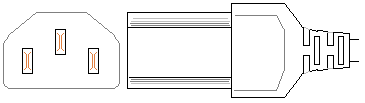
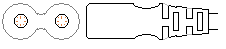
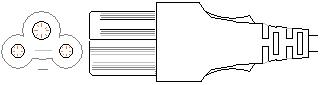
In principle all of these sockets and the equivalent plug can be hand-wired onto cables. In practice this is a fiddly job taking several minutes. Cables are almost always factory made and sealed.

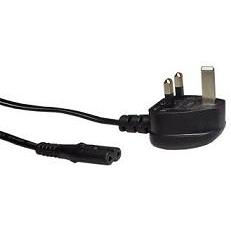
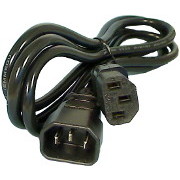
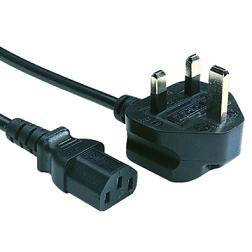
Confusing plugs & Sockets
The design of the IEC connectors causes some terminological confusion because people commonly refer to both ends of the detachable cable as a "plug". The IEC connector on the end of a standard mains cable is a LINE SOCKET not a plug. Connector terminology is based on what the conductors do and the conductors in the line socket are female, whilst those on the inlet or chassis plug are male. (The main body of the socket is plug shaped - but it's the connectors that count). As well as the line socket form there is a line plug which is typically used to connect to a UPS or power distribution strip. Confusion is often avoided by calling the cable with a C14 Line Plug to C13 Line Socket a "hot and cold lead".
The design of the IEC leads is intended to be inherently safe. The "hot" connector is always a socket and recessed into the plastic of the lead or device. The socket is too small for human finger to penetrate to the live connectors. The plug is on the "cold" side - mounted on the device to be powered. When a socket is chassis mounted the mating plug has a plastic skirt round it so fingers can't easily come into contact with the pins as they become live.
Connector Types:
| Female (normally on the Line) | Male or inlet (in the Chassis) | Conductors | Current (Amps) | Temp °C | Remarks |
|---|---|---|---|---|---|
| C1 | C2 | 2 | 0.2A | 70°C | Unpolarised. Typically used on electric shavers. |
| C3 | C4 | 2 | 2.5A | 70°C | |
| C5 | C6 | 3 | 2.5A | 70°C | Polarised and earthed. Typically used on notebook computers to provide an earth. Often called the "Cloverleaf" or "Mickey Mouse" connector |
| C7 | C8 | 2 | 2.5A | 70°C | Unpolarised and not earthed. Typically used for external power bricks on printers, modems and some notebook computers. Often called "Figure of Eight Lead" |
C7 | C8 | 2 | 2.5A | 70°C | Polarised Variant - one side of the "8" is altered to straight or a square pin is used. |
| C9 | C10 | 2 | 6A | 70°C | Unpolarised. Rectangular 2 pin Used inside some equipment. |
| C11 | C12 | 2 | 10A | 70°C | Polarised by a keyway in the moulding but 2 pin similar to the C9/C10 |
| C13 | C14 | 3 | 10A | 70°C | Polarised. This is the most common connector, particularly on computer equipment. Usually comes as a C13 line socket with "regional" plug on the other end. Often incorrectly called a "kettle lead". Also available as "hot and cold" C14 line plug to C13 line socket. |
| C15 | C16 | 3 | 10A | 120°C | Polarised and earthed "hot condition connector". Made from plastic with a higher temperature rating to allow use on devices like kettles. The C16 has a raised bump opposite the earth pin which prevents a C13 fitting it. A C15 has a matching hollow. The kettle lead can be used to power computers with a C14 inlet although it's probably better not to do so. |
| C15A | C16 | 3 | 10A | 155°C | As for the C15 but rated for 155 Centigrade and equipped with an extra plastic key to signify this. |
| C17 | C18 | 2 | 10A | 70°C | Polarised but no earth pin, otherwise like the C13 - C14 Pair. A C13 line socket can be used instead of a C17 - the equipment just won't use the earth. The only common use is on some older Sony Bravia TVs and the Microsoft Xbox 360. |
C19 | C20 | 3 | 16A | 70°C | A rather bigger plug and socket with a higher current rating. Polarised and earthed. Used on high output UPSs and distribution strips. Looks like a large version of the C13 / C14 but plug is rectangular and the pins are parallel to the long axis |
| C21 | C22 | 3 | 16A | 155°C | Looks like a larger version of the C13 - C14 but the pins are horizontal instead of vertical. Possibly used in heating equipment given the temperature rating. Apparently used in IBM power systems. |
| C23 | C24 | 2 | 16A | 70°C | Like the C19 but without a ground pin. |
Safety
All voltage ratings are 250 Volts so the connectors can be used in every country.
The maximum temperature is 70 centigrade unless otherwise stated.
The pins of the C13 line socket are rated at 10 Amps but the kind of equipment that uses these connectors rarely draws more than one amp. Manufacturers have sometimes shown a regrettable tendency to use thin 0.75mm cable with these connectors so the cable may only be rated at 6 Amps.
There is no provision for a fuse inside bog-standard IEC connectors.
Some IEC chassis plugs (and sockets) do have a fuse receptacle built into them, an equipment designer will almost invariably include a fuse inside equipment.
High power equipment like Uninterruptible Power Supplies can deliver more power than some cables might take. Exercise some caution and look at cable ratings before using them in critical situations. If a 6 amp cable is used with equipment that really does draw 10 amps it could overheat and be a fire hazard.
Functionality
The IEC connectors generally provide a neat, small connector for a power lead. They are lowest common denominators rather than the smallest possible connectors for the job but being commonplace and easily replaceable is often more important than being perfectly matched to a task.
The C13 / C14 pair have been most commonly used in IT equipment for many years and this sets up something of a feedback loop promoting its further use. Many computers could have double-insulated power supply circuitry so they might be able to use an unearthed connector like the C17 or a small connector like the C7. However computers were often connected to long communications lines so there may still be an argument in favour of electrically grounding the case.
The C5 / C6 pair are very often used on small computers and notebook power supplies. The C5 connector is a bit lighter but just fractionally smaller in outline than the C13 so its advantage isn't clear. It may be more difficult to damage the power pins on the C6 because the plastic surround leaves them less exposed.
The C7 / C8 connectors genuinely are smaller - the plug is half the size and the 2 conductor light grade wire takes less space as well. It isn't clear why notebook computer makers can't use this connector because many other computer related devices do so.
Many of the other connectors are not at all common. The C3, C21 and C23 presumably have their uses - they just aren't seen very often.
Manufacture
IEC connectors help make equipment cheaper. Manufacturers pay a bit extra to buy a chassis socket for equipment but can then manufacture a single design of equipment and "regionalise" it for the market by shipping a power cord appropriate to the country.
Specialists in connectors and power cords need to make their products to a quality level that makes their products acceptable to system makers but otherwise at the lowest possible cost. This implies mass manufacture on automated production lines so far as possible. The brass connectors are welded to the cable and then coated with plastic in an injection moulding process.
The C7, C13 line socket and C14 line plug and C19 connectors are also sometimes available as screw-on connectors. All are rather fiddly to fit - particularly the C7 - and the end result is not usually as good as a moulded-on cable. The main reason for fitting a C14 Lineplug onto a cable is usually to allow an extension cable in the national style such as BS1363 to be connected to an IEC socket on a UPS.
Non standard items tend to be rather expensive. For instance strips of IEC C13 chassis sockets are available but the price is often surprisingly high. It's simply a matter of demand - as the number of gadgets people have increase, so they are likely to start using IEC distribution strips instead of national style extension blocks.